

FOR TEACHER EDUCATORS & PROGRAM FACULTY
Teaching the content starts with teaching students to understand it.
Prepare teacher candidates for one of the most common challenges new secondary teachers face: helping students understand complex texts so they can learn the content. The Science of Reading for Grades 4–12 equips future educators with practical, research-backed strategies they can use across every content area.
PUBLICATION DATE: 2026

STRATEGIES
70, sequenced by phase
The Science of Reading for Grades 4–12:
Every Subject, Every Day!
Katherine S. McKnight, Ph.D., and Jenny French, Ed.D.
Before-, During-, After-, and Anytime-reading strategies that build content knowledge while they build reading skill. Every strategy is tagged to the Scarborough Reading Rope strands it strengthens, and 67 of the 70 carry their own peer-reviewed citation.
ISBN 978-0999226056 · Paperback · 308 pages · 8.5″ × 11″ · $39.99
Quantity orders and purchase orders: info@engaginglearners.com
Request an examination copy · Free desk copy for adopting faculty · Digital review copy available on request
PEER-REVIEWED CITATIONS
67 of 70 strategies
EXTENT
308 pp. · 8.5″ × 11″
COURSE LEVEL
Undergrad & Graduate
THE PREMISE
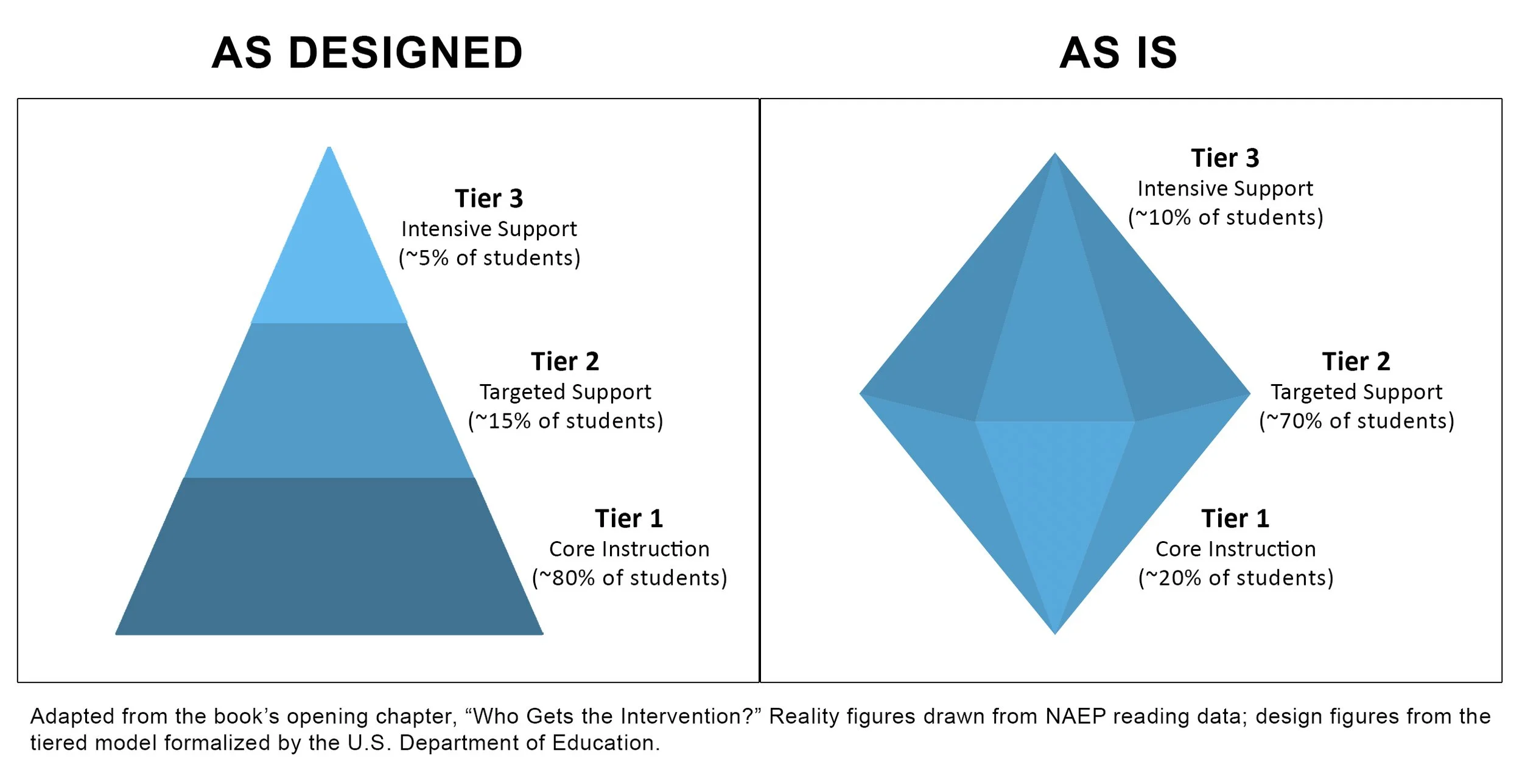
MTSS was designed for a pyramid.
Your candidates are walking into a diamond.
For decades, Multi-Tiered Systems of Support (MTSS) have been built on a predictable shape. A wide base of students succeeds with strong core instruction (Tier I), a smaller group needs targeted support (Tier II), and a small number requires intensive intervention (Tier III). The way most schools are staffed, scheduled, and budgeted still assumes that pyramid holds — that roughly 80% of students arrive ready to learn from grade-level text.
That assumption no longer describes many of today's classrooms. With nearly 70% of students in grades 4–12 reading below proficiency on national assessments, the middle of the distribution has grown and the “ready” base has narrowed. In practice, the pyramid has become a diamond: the largest group of students is no longer the one that thrives on core instruction alone, but the one that needs help accessing the very texts the curriculum is built around.
This is a Tier I problem, and no intervention schedule can absorb it. When most of a class struggles with disciplinary text, the answer cannot be a pull-out group or a specialist's caseload — it has to live inside daily content instruction. Increasingly, effective Tier I teaching includes helping students read, interpret, and learn from the complex texts of science, social studies, mathematics, and other content areas.
The gap this text is built for:
Secondary methods courses that cover pedagogy thoroughly and reading not at all —
in a country where 42 states and D.C. have now passed evidence-based reading laws, and where NCTQ’s 2026 review found roughly one in five preparation programs still teaching discredited word-guessing approaches.
Which puts the burden somewhere your program may not currently be preparing anyone to carry — on the science teacher, the world history teacher, the algebra teacher. Not as dyslexia therapists, but as the adults responsible for making a discipline’s text accessible.
Why this matters for teacher preparation:
• Schools are staffed on the assumption that roughly 80% of students arrive ready for core instruction.
• Nearly 70% of U.S. students are not reading proficiently on NAEP assessments.
• More than 40 states have adopted legislation emphasizing evidence-based reading instruction.
• Secondary content-area teachers are increasingly expected to help students learn from complex texts, yet few resources have been written specifically to prepare future science, social studies, mathematics, and CTE teachers for that work.
ANATOMY OF A STRATEGY
A consistent instructional design that supports analysis and practice.
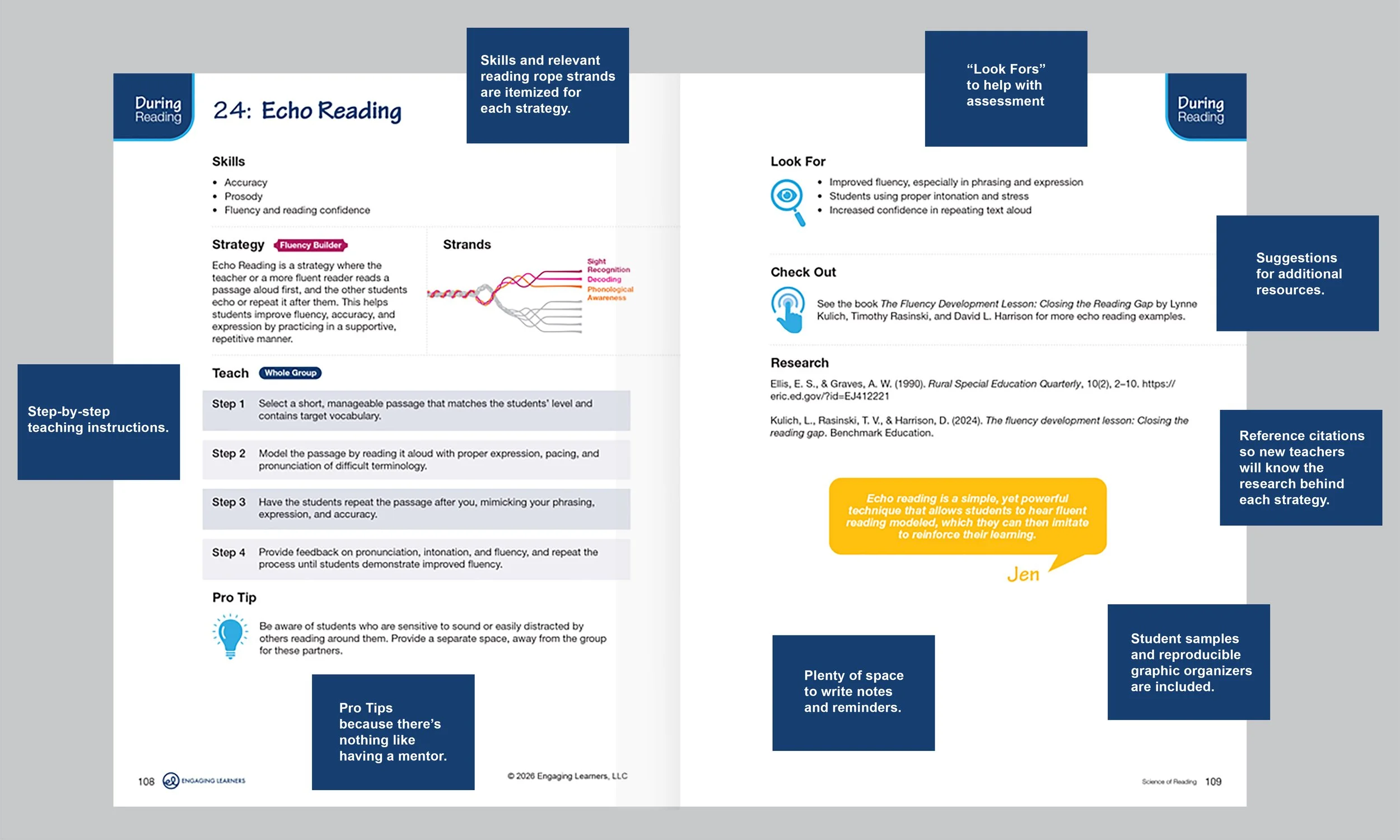
All 70 instructional strategies follow the same research-informed framework. Rather than learning a new format with every chapter, teacher candidates quickly become familiar with the structure, allowing them to focus on what matters most: selecting appropriate strategies, analyzing instructional decisions, and adapting evidence-based literacy practices to authentic disciplinary texts.
Each strategy includes:
• Targeted literacy skills that establish a clear instructional purpose.
• Reading Rope strand connections that connect classroom practice to the Science of Reading.
• Implementation guidance for appropriate instructional settings, including whole-group, small-group, partner, and independent learning.
• Step-by-step instructional procedures that can be adapted across content areas.
• “Look For” indicators that identify observable evidence of student learning and support formative assessment.
• Research citations that encourage candidates to examine the evidence behind each instructional practice.
Presented in an easy-to-use format.
The Science of Reading for Grades 4–12: Every Subject, Every Day! is the book your students will carry into their own classrooms for years to come.
How do we prepare future teachers for students who can't read the textbook?
THE RESEARCH BASE
Research that supports classroom practice.
Rather than separating research from instruction, The Science of Reading for Grades 4–12 embeds evidence throughout the book. Every instructional strategy is connected to the research that supports it, helping teacher candidates understand not only how to implement a strategy, but why it works.
The Simple View
Reading comprehension is the product — not the sum — of decoding and language comprehension. Strength in one cannot compensate for weakness in the other. This is why a fluent reader can be a non-comprehender, and why secondary teachers cannot diagnose by listening.
Gough & Tunmer (1986)
Scarborough’s Rope
By grade 4, word recognition should be automatic and the instructional weight shifts to the language comprehension strands: background knowledge, vocabulary, language structures, verbal reasoning, literacy knowledge. Every strategy in the book is tagged to the strands it strengthens.
Scarborough (2001); Dehaene (2009)
Disciplinary literacy
Generic “content-area reading” under-serves the disciplines. Reading a lab report, a primary source, and a proof are different cognitive acts. Achievement rises when content teachers implement research-based literacy routines alongside ELA rather than outsourcing them to it.
Shanahan & Shanahan (2008); Hattie (2016)
The book also takes the affective side seriously and cites it: shame and anxiety measurably reduce working memory available for the task, which reframes the disengaged reader in the back row as a cognitive-load problem rather than a discipline problem.
Beilock, 2011; Immordino-Yang & Damasio, 2007; Darling-Hammond et al., 2020.
STANDARDS ALIGNMENT
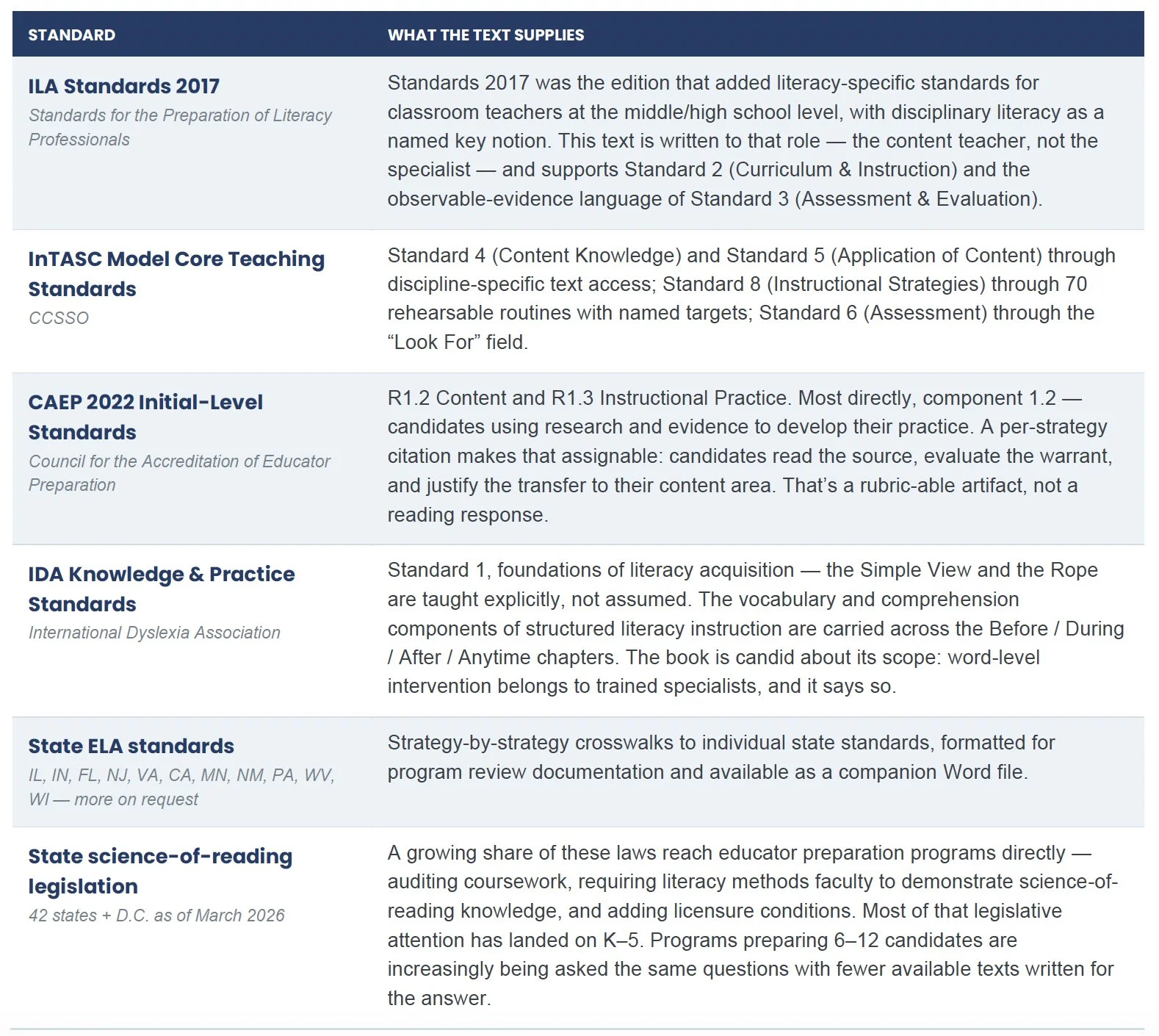
This text earns its place in your syllabus — and in your accreditation file.
The mapping below is Engaging Learners’ crosswalk, offered so you can verify it against your program’s evidence requirements rather than take it on faith.
Full state-by-state ELA standards crosswalks are available on request.
COURSE FIT
Where faculty are using it.
Content-Area / Disciplinary Literacy methods
The primary fit. Works as the sole text for a 3-credit course: the introduction carries the theory, the four chapters carry the sequence, and the student samples carry the analysis.
Secondary graduate programs & alternative certification
Written for career-changers who have deep content knowledge and no reading coursework. No prior literacy vocabulary assumed; no prior literacy vocabulary assumed.
Special Education methods
The “instructional casualty” discussion — distinguishing disability from the absence of adequate instruction — is a rare, teachable treatment of a question your candidates will face in an eligibility meeting within their first year.
Adolescent Literacy
Pairs the reader-type framework — non-decoder, dysfluent, non-comprehender — with strategy selection, so identification and response are taught as one act rather than two units.
Reading Specialist programs
As the Tier I companion. Specialists graduating into coaching roles need something to hand to the chemistry department on a Tuesday. This is that thing.
Clinical practice & student teaching
Numbered strategies give supervisors a shared referent. “Try doing a Think Aloud (that’s strategy 19) with that text” is a coaching move; “scaffold more” is not.
THE AUTHORS
Written by two people who have taught the course you’re teaching.
Katherine S. McKnight, Ph.D.
AUTHOR · PROFESSOR · CONSULTANT
Three decades in education, from high school classrooms to a university career, and the author of roughly 25 books for educators. Her work centers on practical, research-grounded strategies for content-area teachers — the material of the methods course, written by someone who has stood in front of one.
Jenny French, Ed.D.
AUTHOR · FORMER ASSISTANT SUPERINTENDENT
Elementary teacher, middle school language arts teacher, secondary literacy coach, associate professor, curriculum director, assistant superintendent. She developed a foundational reading and linguistics curriculum for struggling adolescent readers; her current work is the science of reading for adolescents, implementation science, and coaching school leaders.
THE TEACHER’S GUIDE
PUBLICATION DATE: 2026
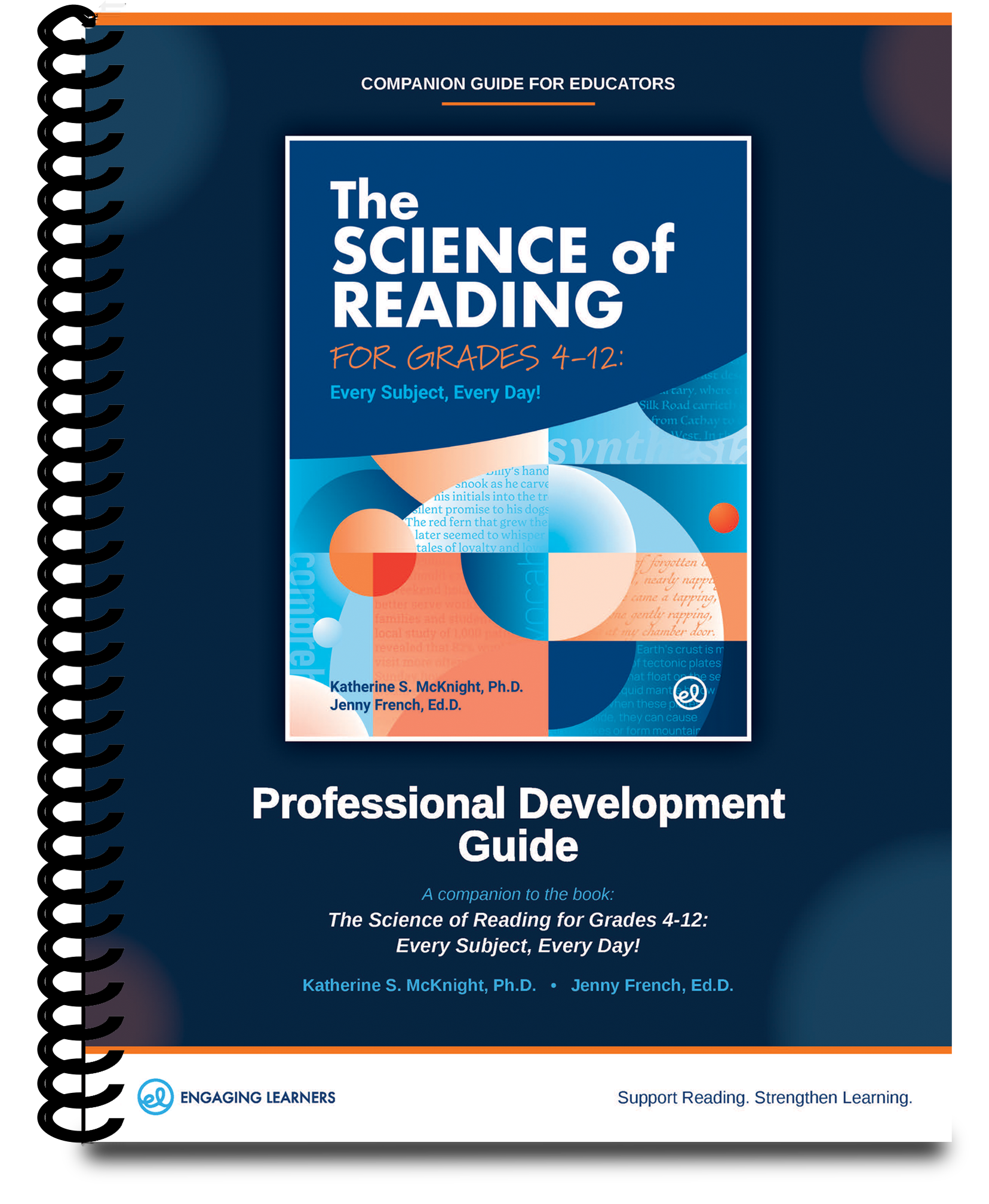
Professional Development Guide: A Companion to The Science of Reading for Grades 4–12: Every Subject, Every Day!
The companion Professional Development Guide helps professors bring the book to life in the classroom. With discussion prompts, reflection activities, planning templates, and practical tools, students build a deeper understanding of course content while experiencing the evidence-based literacy strategies they'll use with their own students. Professors can model these instructional practices, showing future educators how to turn research into meaningful classroom instruction.
ISBN 978-0999226063 · Paperback · 72 pages · 8.5″ × 11″ · $24.99
Because training the next generation of teachers is demanding.
EXAMINATION COPIES
Read it before you assign it.
Tell us the course, the term, and roughly how many candidates, and we’ll send a review copy. Adopting faculty receive a desk copy at no cost, plus the state standards crosswalk for your program’s state, and the companion Professional Development Guide.